

Data Center Impact Hinges on Design Choices and Commitments
This year RAEDEN published a Fact or Fiction Series on LinkedIn that served to rebut some common concerns about data centers. The series covered property values, electricity rates, water consumption, and noise levels. We’ve compiled these posts from our LinkedIn series to show that there are many choices involved when it comes to data center development. There is no one-size-fits-all solution, nor are data centers inherently bad for communities. They can use millions of gallons of water or zero gallons of water. They can be loud, or they can be as quiet as a library.
How a data center affects a community hinges on design choices, and the operators’ commitments and obligations.
Are Data Centers Loud?
When compared to industrial activities, the sound generated by most data centers is quite low. Sound levels depend on and vary significantly by design.
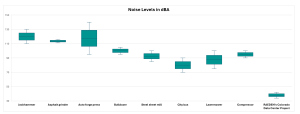
Sources: Noise Navigator Sound Level Database by 3M and University of Michigan, softdb.com/blog/industrial-noise
Some data centers, especially older ones that use evaporative cooling, have cooling towers outside their facilities that generate substantial noise (75-95 dB), similar to that of a city bus (70-90 dB). Cryptocurrency or Bitcoin mining facilities utilize a multitude of fans exposed to the outside air to cool equipment. Unattenuated sound from cryptocurrency mining can produce up to 85 dBA of continuous noise. Unlike operators of enterprise and AI data centers, Bitcoin miners have little incentive to mitigate noise or temperature, as their hardware is relatively cheap and rugged in comparison.
Most data centers have back-up generators, often located outside. Generators run if there is a power outage and briefly during maintenance tests (about 30 minutes once a month). Without sound barriers, diesel generators’ noise levels are between 75-105 dB when active.
Operators can opt to install sound barriers, such as barrier wall systems, acoustic louvres, absorption panels, and attenuators/silencers to significantly reduce these sound levels. In RAEDEN’s case, we pay more to have sound attenuation added to equipment, build sound attenuating walls to surround chillers and generators. Studies show that our sound levels at the property line are below 45 dBA, or the equivalent of a quiet library.
Do Data Centers Use a lot of Water?
Again, the answer varies significantly by design, and if compared to industrial or even recreational activities, data centers do not use a lot of water.

Sources: https://www.nona-technologies.com/blog/data-center-water-consumption, https://insideclimatenews.org/news/03092025/corpus-christi-folds-on-its-desalination-gamble/, https://www.gpb.org/news/2025/08/07/hyundai-quiet-on-local-water-use, https://spectrumnews1.com/oh/columbus/news/2022/09/25/intel-s-water-reclamation-goals
Some modern data centers, like RAEDEN’s, use closed-loop cooling to continuously recycle water with little to no waste. Some use immersion cooling where computing equipment is submerged in dielectric fluid. Both of these methods waste little to no water.
One way to gauge how efficiently data centers use water for cooling is a metric called WUE, or Water Usage Effectiveness. WUE is calculated by dividing a data center’s water consumption by IT energy consumption over a fixed time period. The closer the result is to zero, the more efficient the water usage.
Water Effectiveness for Various Cooling Methods
| Cooling Type | Estimated WUE | Water Waste | Description |
|---|---|---|---|
| Air cooling | 0 | none | Uses fans and heat exchangers with no water, but energy use is high. |
| Immersion cooling | 0 – 0.05 | little to none | Servers are submerged in dielectric fluid to keep them cool. |
| Direct-to-chip | 0.02 – 0.2 | very little | Closed-loop liquid circulates directly over chips; minimal top-off. |
| Adiabatic cooling | 0.2 – 0.7 | moderate | Uses water evaporation only on the hottest days to pre-cool air. |
| Evaporative cooling | 1.5 – 2.5 | High | Primary cooling through water evaporation; high consumption. |
| Chilled water towers | 2.0 – 3.0+ | very high | Traditional open-loop systems with high evaporation and “blowdown” waste. |
Source:https://www.datacenterknowledge.com/cooling/a-guide-to-data-center-water-usage-effectiveness-wue-and-best-practices
Do Data Centers Raise Electricity Rates?
They have but the opposite is also true. In places where data centers have raised electricity rates, governments and developers passed on the costs of infrastructure upgrades and new power acquisition to residential ratepayers. Data center companies should cover 100% of the costs to supply the power they need, including infrastructure upgrades, and in many cases they are. RAEDEN covers 100% of our power and infrastructure costs, and increasingly, so are hyperscalers like Meta and Google.
A lot of ratepayers across the U.S. are seeing rate hikes not because of data centers, but because of our aging power grid. When governments, utility companies, and data center developers work together, they can contractually ensure that data centers do not raise utility rates, and that large data centers make the grid more reliable and even lower rates for residential consumers.
“It’s like sharing gas costs on a road trip — the more people in the van, the less each one pays.” -DTE Energy
There are several examples of data centers lowering rates and making service more reliable:
- This year, Indiana Michigan Power announced that they will be cutting base rates due to increased revenue from large-load customers, including data centers. Additionally, they announced a 32% improvement in service reliability over the past 5 years.
- Last year, contract structures between data center companies and utilities. This normally entails data center companies paying tariffs to cover their power generation needs, including infrastructure upgrades.
These benefits to ratepayers result from a combination of policies and contract structures between data center companies and utilities. This normally entails data center companies paying tariffs to cover their power generation needs, including infrastructure upgrades.
Do Data Centers Decrease Property Values?
In most cases, no. Multiple studies have shown that the presence of data centers has either no impact on home values, or they correlate with higher home values in regions across the U.S. Several recent studies have become available on this issue, and more are in the works.
- A study from George Mason University found that in Northern Virginia, home to the nation’s largest concentration of data centers, home values were higher. They also found the further homes were from a data center, the lower the home values were.
- This study from the National Bureau of Economic Research examines the local impacts of data centers across the country. In their initial draft, they write that data centers are associated with higher home values and higher income levels.
- This study from the University of Rochester found no effect of data center permitting on nearby residential property values.
When communities, data center developers and operators, utilities, and governments work together, they can ensure data centers do not negatively impact consumers or the environment. They must work together to examine all the design choices that are available to them, technically and contractually, and choose the right combination of equipment and policies to serve their communities. In Colorado Springs, RAEDEN has collaborated with the community to establish a first-of-its-kind contractual agreement with the City to enforce monitoring, reporting, and sound levels for our data center project. Alberta, Canada is another example of local government collaborating with companies and communities to establish their vision, goals, and policies for data center development. Collaboration is the way we move forward and ensure the future of our economy benefits all.